Showing posts with label Detroit Tigers. Show all posts
Tuesday, March 5, 2013
Could Rick Porcello be the Tigers closer?
By Sean Gagnier
@SeanGagnier
From Day One, the Tigers have said that Bruce Rondon was their first choice to be the closer this season. The rest of the baseball world wondered, why would they pick a rookie who is walk-happy? Well, Detroit appears to be having second thoughts.
In 3.2 innings of work Rondon has failed to get a 1-2-3 inning, allowed five hits, three runs, walked five and posted a 2.72 WHIP. None of which are what you like to see out of a closer, so it appears General Manager Dave Dombrowski will have to start looking elsewhere for his hammer out of the bullpen.
Detroit is supposedly looking outside the organization for a closer to trade for, likely trying to use Rick Porcello as trade bait to see what they can get for him. But finding a closer is hard, and trading for a proven one is even harder.
The logical place to look for a closer is Washington, where the signing of Rafael Soriano has left Drew Storen and Tyler Clippard on the outside looking in. Although the Nationals has a glut of closer-types, signs out of D.C. are that they aren't looking to part with them readily, if at all.
Perhaps the Red Sox' Andrew Bailey would appeal to the Tigers, but from all accounts the two clubs have yet to speak at any length in regard to the closer. That could change however, with Detroit looking to nab themselves a late-inning man quickly.
With the closer market being as thin as it is, Detroit could look within to fill the role. The obvious choices would be either Phil Coke, Octavio Dotel or Joaquin Benoit, but they each serve a valuable role in the bullpen and struggle with batters on the other side of the plate. Could the solution be the man Detroit has been trying to trade away?
What if Porcello was the closer? That would allow Drew Smyly the fifth spot in the rotation. And what features does one look for in a closer? They must be able to throw strikes and get ground balls that can easily be turned into outs. Porcello does both of those things.
As a ground ball, contact-pitcher Porcello is often at the mercy of his defense over the length of a typical start. But as a closer, Porcello could get a few grounders and get off the mound quickly. In a typical Porcello start, he starts strong and starts to struggle as the game goes on. So using that, the shorter his outings the better his performance.
Porcello still gets his ground balls and makes contact with the bat, which is how you know he's on his game, but as long as the defense behind him can turn three grounders into outs he could be a great closer.
Wednesday, February 20, 2013
Tigers Octavio Dotel says Miguel Cabrera isn't a leader
By Sean Gagnier
Octavio Dotel has been on 13 teams and in 752 MLB games, meaning that he knows what goes on in the locker room and what needs to be said in crunch time. Which is perhaps why Dotel told Yahoo! Sports that teammate Miguel Cabrera was not a leader because he didn't call a team meeting during the World Series last season.
It is surprising that Dotel would bring this up during Spring Training, which is usually a happy time when there is very little controversy, but there could be a kernel of truth to this statement.
When Victor Martinez went down, there was an obvious leadership vacuum on the Tigers that was never really filled. The 2011 Tigers were lead by Martinez and his son "Little Victor," but 2012 brought with it no new leaders for Detroit.
General Manager Dave Dombrowski has said that his team lacks leadership before, and even manager Jim Leyland has said that Cabrera isn't vocal in the locker room and that his personality doesn't lend itself to being a clubhouse leader.
So take it as you may, but perhaps the wily veteran of 13 ballclubs could just be right, and the Tigers need to find themselves a new leader.
Tuesday, February 12, 2013
2013 American League Predictions
By Sean Gagnier
American League East
Tampa Bay Rays
Tampa pulled off a huge trade with the Kansas City Royals after last season, sending Wade Davis and James Shields to the Royals in exchange for top prospects Wil Myers and Jake Ororizzi to Tampa.
The Rays already had excellent pitching, so they were able to trade away some of it in order to fleece the Royals for their best prospects.
Tampa retained slugger Evan Longoria and added several key position players, such as Kelly Johnson and Yunel Escobar. If the Rays offense can get things rolling, their pitching will carry them the remainder of the season.
There may be a fight to be had with the Blue Jays or Yankees down the stretch, but this is Tampa's division to lose at this point.
American League Central
Detroit Tigers
It's hard not to see Detroit winning this division for a third straight season, with the addition of Torii Hunter and Victor Martinez coming back from an ACL tear, this team is the best on paper going into 2013.
Hunter wanted nothing more than to join the Tigers this offseason, and he got his wish. He will lock down a right field in Comerica Park and provide a solid fixture in the No. 2 spot in the order ahead of Miguel Cabrera and Prince Fielder.
Did you forget about them? The Triple Crown winner and one of the scariest bats in the game?
Offense will not be a problem for the Tigers this season, neither will pitching, as Detroit resigned Anibal Sanchez and made perhaps the strongest rotations in the game.
What will make or break the Tigers will be their bullpen. Just like in 2012, if the Tigers struggle to close out games then the Central will be a tight race, but if Bruce Rondon is what Detroit says, then this division could be wrapped up by July.
American League West
Los Angeles Angels of Anaheim
The Angels are perhaps the most intimidating team, but after a lackluster year last season, it remains to be seen if they can put together a solid season.
Last year the baseball world was abuzz as the Angels brought in Albert Pujols, this year, they opened the checkbook again and brought in Josh Hamilton. Add those two to the impressive young duo of Mark Trumbo and Mike Trout and Los Angeles will scare any opposing pitcher.
Ryan Madson was brought in to fill the closers role for the Halos, but the starting pitching is what will propel this team in one direction or the other. Yes, the Angels boast Jered Weaver and C.J. Wilson, but after that, the order falls to Tommy Hanson, Joe Blanton and Jason Vargas. Not exactly an All-Star lineup.
While the Angels have stocked up on big bats, they have let their pitching slump and have gotten slower on the basepaths. A traditional Los Angeles team is one that puts pressure on the pitcher with the threat of stealing a base, but with as many big bats as they now have, the base stealing numbers won't be as high.
If they can adapt to become a slugging team and get some solid pitching out of the bottom of their rotation then they will beat out the Oakland Athletics for the division.
American League Wild Card
Toronto Blue Jays
The Blue Jays pulled off two big trades in the offseason, netting R.A. Dickey, Mark Buerhle, Josh Johnson, Jose Reyes, Josh Thole and Mark Nickeas. Safe to say, they improved themselves.
Toronto's rotation now looks like this; Dickey, Johnson, Brendan Morrow, Buerhle, and Ricky Romero. Now that's a rotation that can compete in the AL East.
In addition to a much improved pitching staff, the Jays still have Jose Bautista's bat and Reyes' legs, not to mention the offseason signing of Melky Cabrera. If Cabrera can still mash without his PED's he will help make this Jays team quite formidable in the AL East.
Who knows, if the Rays can't get their offense going, the AL East crown could easily be heading north of the border in 2013.
New York Yankees
It hasn't been the best couple of months for the Yankees, first Derek Jeter breaks his ankle in the ALCS and then Alex Rodriguez becomes embroiled in yet another PED scandal.
That aside, this is still an impressive team on paper. Names like Jeter, Rodriguez, Mark Teixeira and Robinson Cano just jump off the roster at you.
The Bronx Bombers resigned Ichiro Suzuki, brought in Travis Hafner and should have a healthy Brett Gardner to start the 2013 season. In a bam-box like Yankee Stadium, those names will produce very lopsided numbers.
However, like last season, it will all depend on the pitching. Sure, C.C. Sabathia is back, but after that, the rotation leaves a lot to be desired. Following Sabathia is Hiroki Kuroda, Andy Pettite, Phil Hughes and Ivan Nova.
Questions also surround the bullpen, that will have Mariano Rivera return, but his effectiveness is yet to be seen after season ending surgery last year. His mid-season replacement, Rafael Soriano, has yet to find a home this offseason, meaning that should Rivera not be his old self, or should something happen to him, the Yankees will be scrambling for bullpen help.
New York could go either way, but will be in a fight with the Orioles all season to hold onto a wild card spot at the very least.
American League Champion: Detroit Tigers
American League East
Tampa Bay Rays
Tampa pulled off a huge trade with the Kansas City Royals after last season, sending Wade Davis and James Shields to the Royals in exchange for top prospects Wil Myers and Jake Ororizzi to Tampa.
The Rays already had excellent pitching, so they were able to trade away some of it in order to fleece the Royals for their best prospects.
Tampa retained slugger Evan Longoria and added several key position players, such as Kelly Johnson and Yunel Escobar. If the Rays offense can get things rolling, their pitching will carry them the remainder of the season.
There may be a fight to be had with the Blue Jays or Yankees down the stretch, but this is Tampa's division to lose at this point.
American League Central
Detroit Tigers
It's hard not to see Detroit winning this division for a third straight season, with the addition of Torii Hunter and Victor Martinez coming back from an ACL tear, this team is the best on paper going into 2013.
Hunter wanted nothing more than to join the Tigers this offseason, and he got his wish. He will lock down a right field in Comerica Park and provide a solid fixture in the No. 2 spot in the order ahead of Miguel Cabrera and Prince Fielder.
Did you forget about them? The Triple Crown winner and one of the scariest bats in the game?
Offense will not be a problem for the Tigers this season, neither will pitching, as Detroit resigned Anibal Sanchez and made perhaps the strongest rotations in the game.
What will make or break the Tigers will be their bullpen. Just like in 2012, if the Tigers struggle to close out games then the Central will be a tight race, but if Bruce Rondon is what Detroit says, then this division could be wrapped up by July.
American League West
The Angels are perhaps the most intimidating team, but after a lackluster year last season, it remains to be seen if they can put together a solid season.
Last year the baseball world was abuzz as the Angels brought in Albert Pujols, this year, they opened the checkbook again and brought in Josh Hamilton. Add those two to the impressive young duo of Mark Trumbo and Mike Trout and Los Angeles will scare any opposing pitcher.
Ryan Madson was brought in to fill the closers role for the Halos, but the starting pitching is what will propel this team in one direction or the other. Yes, the Angels boast Jered Weaver and C.J. Wilson, but after that, the order falls to Tommy Hanson, Joe Blanton and Jason Vargas. Not exactly an All-Star lineup.
While the Angels have stocked up on big bats, they have let their pitching slump and have gotten slower on the basepaths. A traditional Los Angeles team is one that puts pressure on the pitcher with the threat of stealing a base, but with as many big bats as they now have, the base stealing numbers won't be as high.
If they can adapt to become a slugging team and get some solid pitching out of the bottom of their rotation then they will beat out the Oakland Athletics for the division.
American League Wild Card
Toronto Blue Jays
The Blue Jays pulled off two big trades in the offseason, netting R.A. Dickey, Mark Buerhle, Josh Johnson, Jose Reyes, Josh Thole and Mark Nickeas. Safe to say, they improved themselves.
Toronto's rotation now looks like this; Dickey, Johnson, Brendan Morrow, Buerhle, and Ricky Romero. Now that's a rotation that can compete in the AL East.
In addition to a much improved pitching staff, the Jays still have Jose Bautista's bat and Reyes' legs, not to mention the offseason signing of Melky Cabrera. If Cabrera can still mash without his PED's he will help make this Jays team quite formidable in the AL East.
Who knows, if the Rays can't get their offense going, the AL East crown could easily be heading north of the border in 2013.
New York Yankees
It hasn't been the best couple of months for the Yankees, first Derek Jeter breaks his ankle in the ALCS and then Alex Rodriguez becomes embroiled in yet another PED scandal.
That aside, this is still an impressive team on paper. Names like Jeter, Rodriguez, Mark Teixeira and Robinson Cano just jump off the roster at you.
The Bronx Bombers resigned Ichiro Suzuki, brought in Travis Hafner and should have a healthy Brett Gardner to start the 2013 season. In a bam-box like Yankee Stadium, those names will produce very lopsided numbers.
However, like last season, it will all depend on the pitching. Sure, C.C. Sabathia is back, but after that, the rotation leaves a lot to be desired. Following Sabathia is Hiroki Kuroda, Andy Pettite, Phil Hughes and Ivan Nova.
Questions also surround the bullpen, that will have Mariano Rivera return, but his effectiveness is yet to be seen after season ending surgery last year. His mid-season replacement, Rafael Soriano, has yet to find a home this offseason, meaning that should Rivera not be his old self, or should something happen to him, the Yankees will be scrambling for bullpen help.
New York could go either way, but will be in a fight with the Orioles all season to hold onto a wild card spot at the very least.
American League Champion: Detroit Tigers
Monday, February 11, 2013
Tigers' tickets will cost you more in 2013
By Sean Gagnier
It's to be expected right? When your city has a competitive baseball team with three superstars, you would expect ticket prices would be on the high end. Well, Detroit fans will soon feel the true cost of a contender.
As if last year's ticket prices weren't confusing enough, there will now be three price tiers when purchasing Tigers tickets; premium, regular and value.
Value pricing is for most games in April, May and September, with Opening Day excluded. The value pricing is meant to attract fans during school-months when the stadium is usually below capacity. Premium pricing will apply for most summer weekend games and matchups with high-profile teams, such as the Yankees or Red Sox. The regular pricing will cover the remainder of games.
Mr. Mike Ilitch will still sell you a pizza for $5, but you can no longer go see his baseball team for a fiver. The popular "Skyline" seats, code for nosebleed, will increase from $5 to $20 for premium games, $15 for regular games and $12 for value games.
Bleacher seats will also see a hefty price hike in 2013, jumping from $17 for premium games and $15 for regular games last year to $23 for premium and $18 for regular and value games.
The skyline and bleacher seats will see the highest percentage increase for 2013, but most tickets are increasing by about $5 this season.
Full ticket prices listed below (premium/regular/value), with 2012 prices (premium/regular) in parentheses.
Lower Level Tickets
On-deck circle: $90/$85/$77 ($85/$75)
Tiger den: $85/$80/$72 ($80/$70)
Infield box: $65/$60/$52 ($60/$50)
Terrace: $58/$53/$45 ($53/$43)
Outfield box: $52/$47/$39 ($47/$37)
Lower baseline box: $43/$38/$30 ($38/$28)
Right-field grandstand: $36/$31/$23 ($31/$21)
Pavilion: $26/$21/$19 ($21/$17)
Bleachers: $23/$18/$18 ($17/$15)
Kaline's Corner: $23/$18/$18 ($18/$16)
Upper Level Tickets
Club seats: $41/$36/$33 ($36/$31)
Upper box infield: $35/$30/$26 ($30/$26)
Upper box right field: $35/$30/$26 ($30/$24)
Upper box left field: $35/$30/$25 ($30/$24)
Upper baseline box: $30/$25/$21 ($25/$19)
Mezzanine: $25/$20/$18 ($20/$16)
Upper reserved: $24/$19/$16 ($19/$14)
Skyline: $20/$15/$12 ($5/$5)
Standing-room only: N/A ($17/$15)
It's to be expected right? When your city has a competitive baseball team with three superstars, you would expect ticket prices would be on the high end. Well, Detroit fans will soon feel the true cost of a contender.
As if last year's ticket prices weren't confusing enough, there will now be three price tiers when purchasing Tigers tickets; premium, regular and value.
Value pricing is for most games in April, May and September, with Opening Day excluded. The value pricing is meant to attract fans during school-months when the stadium is usually below capacity. Premium pricing will apply for most summer weekend games and matchups with high-profile teams, such as the Yankees or Red Sox. The regular pricing will cover the remainder of games.
Mr. Mike Ilitch will still sell you a pizza for $5, but you can no longer go see his baseball team for a fiver. The popular "Skyline" seats, code for nosebleed, will increase from $5 to $20 for premium games, $15 for regular games and $12 for value games.
Bleacher seats will also see a hefty price hike in 2013, jumping from $17 for premium games and $15 for regular games last year to $23 for premium and $18 for regular and value games.
The skyline and bleacher seats will see the highest percentage increase for 2013, but most tickets are increasing by about $5 this season.
Full ticket prices listed below (premium/regular/value), with 2012 prices (premium/regular) in parentheses.
Lower Level Tickets
On-deck circle: $90/$85/$77 ($85/$75)
Tiger den: $85/$80/$72 ($80/$70)
Infield box: $65/$60/$52 ($60/$50)
Terrace: $58/$53/$45 ($53/$43)
Outfield box: $52/$47/$39 ($47/$37)
Lower baseline box: $43/$38/$30 ($38/$28)
Right-field grandstand: $36/$31/$23 ($31/$21)
Pavilion: $26/$21/$19 ($21/$17)
Bleachers: $23/$18/$18 ($17/$15)
Kaline's Corner: $23/$18/$18 ($18/$16)
Upper Level Tickets
Club seats: $41/$36/$33 ($36/$31)
Upper box infield: $35/$30/$26 ($30/$26)
Upper box right field: $35/$30/$26 ($30/$24)
Upper box left field: $35/$30/$25 ($30/$24)
Upper baseline box: $30/$25/$21 ($25/$19)
Mezzanine: $25/$20/$18 ($20/$16)
Upper reserved: $24/$19/$16 ($19/$14)
Skyline: $20/$15/$12 ($5/$5)
Standing-room only: N/A ($17/$15)
Sunday, February 10, 2013
Tigers look to add a right-handed bat
By Sean Gagnier
Despite boasting one of the most formidable offenses in baseball, the Tigers are still on the prowl for additional offense. General Manager Dave Dombrowski has expressed that he is still looking for a right-handed bat that can fill part-time roles in the order.
Don't expect the Tigers to hit the free agent market soon however, as Dombrowski pointed out, he would prefer to fill the role internally. There are several options the Tigers have for a right-handed batter, namely, Danny Worth and minor league 2B/SS Jeff Kobernus.
Worth has major league experience with the Tigers, turning in a .216 batting average in 90 plate appearances with Detroit last season. Although his batting average was not what the Tigers wanted, his on-base percentage hovered around .330 for the season. He also has proven that he is a capable stop-gap on the infield when the need arises.
Kobernus, 24, has yet to play in the majors after being drafted in the 2nd round of the 2009 draft by the Washington Nationals. The infielder has steadily increased his batting average in each of his four professional seasons, ultimately recording a .282 batting average with Double-A Harrisburg in 2012. Kobernus reached base at a .325 rate last season, making him valuable to his club.
While Detroit is looking for a righty-hitter, they are not necessarily looking for another power hitter, as evidenced by their interest in Worth and Kobernus. The Tigers have the pop they need in the lineup, what this team needs now are role players that can play consistently and stay healthy. Worth and Kobernus appear to fill those roles. Look for both to get extended playing time in Spring Training to determine who will go north with the club.
Despite boasting one of the most formidable offenses in baseball, the Tigers are still on the prowl for additional offense. General Manager Dave Dombrowski has expressed that he is still looking for a right-handed bat that can fill part-time roles in the order.
Don't expect the Tigers to hit the free agent market soon however, as Dombrowski pointed out, he would prefer to fill the role internally. There are several options the Tigers have for a right-handed batter, namely, Danny Worth and minor league 2B/SS Jeff Kobernus.
Worth has major league experience with the Tigers, turning in a .216 batting average in 90 plate appearances with Detroit last season. Although his batting average was not what the Tigers wanted, his on-base percentage hovered around .330 for the season. He also has proven that he is a capable stop-gap on the infield when the need arises.
Kobernus, 24, has yet to play in the majors after being drafted in the 2nd round of the 2009 draft by the Washington Nationals. The infielder has steadily increased his batting average in each of his four professional seasons, ultimately recording a .282 batting average with Double-A Harrisburg in 2012. Kobernus reached base at a .325 rate last season, making him valuable to his club.
While Detroit is looking for a righty-hitter, they are not necessarily looking for another power hitter, as evidenced by their interest in Worth and Kobernus. The Tigers have the pop they need in the lineup, what this team needs now are role players that can play consistently and stay healthy. Worth and Kobernus appear to fill those roles. Look for both to get extended playing time in Spring Training to determine who will go north with the club.
Sunday, January 27, 2013
MLB bans third-to-first pickoff
By Sean Gagnier
@SeanGagnier
The owners have spoken, and the third-to-first pickoff move is history. While the move very rarely worked, it was a favorite of some pitchers who wanted to keep runners honest. With runners on first and third, the pitcher would fake a pickoff throw to third prior to throwing to first, in an attempt to catch the runner leaning toward second.
The rules commission has decided that this move will now be considered a balk. It was deemed a balk because of its incredibly low success rate. It was seen as being nothing more than a waste of time and the definition of a balk.
Many pitchers would use the move to buy time for a reliever in the bullpen or simply to annoy runners on base. The move so rarely worked, you could likely count the successful times on one hand, that it was used more to see if a runner could be caught off guard or a batter tip his hand.
But looking at the move in detail shows that it fits the definition of a balk almost to a T. The pitcher motions forward prior to spinning to third and then pivoting back to first. If that isn't a balk then someone needs to redefine the term.
The banning of this move will likely have very little effect on the game, as so few pitchers actually attempted it. But it could serve to speed the game up a bit and could give a slight edge to baserunners who no longer have to worry about a trick-move catching them off the bag.
With one common sense rule change made, maybe the MLB can step into the 21st century and get some instant replay like the rest of the world.
@SeanGagnier
The owners have spoken, and the third-to-first pickoff move is history. While the move very rarely worked, it was a favorite of some pitchers who wanted to keep runners honest. With runners on first and third, the pitcher would fake a pickoff throw to third prior to throwing to first, in an attempt to catch the runner leaning toward second.
The rules commission has decided that this move will now be considered a balk. It was deemed a balk because of its incredibly low success rate. It was seen as being nothing more than a waste of time and the definition of a balk.
Many pitchers would use the move to buy time for a reliever in the bullpen or simply to annoy runners on base. The move so rarely worked, you could likely count the successful times on one hand, that it was used more to see if a runner could be caught off guard or a batter tip his hand.
But looking at the move in detail shows that it fits the definition of a balk almost to a T. The pitcher motions forward prior to spinning to third and then pivoting back to first. If that isn't a balk then someone needs to redefine the term.
The banning of this move will likely have very little effect on the game, as so few pitchers actually attempted it. But it could serve to speed the game up a bit and could give a slight edge to baserunners who no longer have to worry about a trick-move catching them off the bag.
With one common sense rule change made, maybe the MLB can step into the 21st century and get some instant replay like the rest of the world.
Saturday, January 5, 2013
Why Ex-Tiger Jack Morris Should Not Be a Hall of Famer
By Sean Gagnier
@SeanGagnier
With the Baseball Writers Association of America preparing to vote the next class of players into Cooperstown on Jan. 9th, there are several players who are making a push for the Hall that statistically do not deserve it. There are others, that are being overlooked that are indeed worthy of enshrinement.
Ex-Tiger and Twin Jack Morris has found a new life in his pursuit of the Hall of Fame of late, but with the rise of sabermetrics, his numbers, when looked at in comparison to a similar player that was denied the Hall, could also deny Morris.
And they should.
Morris is close to reaching that magic 75 percent of the vote, but should he even be this close? No.
Yes, Morris had a fantastic Game 7 in 1991, but that does not make someone a Hall of Famer. Consistent solid numbers do, and Morris does not have that.
Morris played 18 seasons with four teams, amassing 254 wins in that time. But a deeper look into those numbers shows that he was an average pitcher, at best.
During his career, Morris posted a 3.90 ERA, that is far less than good. A pitcher with a borderline 4.00 ERA shouldn't be on the mound, let alone in Cooperstown. ERA can sometimes be misleading, so perhaps a look at Morris' WHIP would help his case? Not at all.
In fact, Morris' career 1.29 WHIP is near the high end of acceptable and bordering on demotion level for a starting pitcher. That 1.29 WHIP means that Morris allowed quite a few base-runners each time he was on the mound. A Hall of Famer should be one that keeps runners off the bases, or at least strands them, Morris' numbers show that he did neither.
Delving deeper into sabermetrics gives voters the ERA+ stat, which is a pitchers ERA adjusted to the pitchers ballpark. An average pitcher would score a 100 in the ERA+, meaning anything over 100 is below average and anything under is above average.
Morris' records show that he has a career 105 ERA+, showing that even in the cavernous confines of Tiger Stadium, where he spent 14 seasons, he was unable to post even numbers comparable to the generic average pitcher.
Maybe some voters would argue that the regular season doesn't matter as much as the post season and that Morris' playoff numbers should get him to Cooperstown. Well, they don't. They damn him almost as much as his regular season numbers.
In seven playoff series, Morris played in 13 games and turned in a 3.80 ERA, not exactly the ace performance expected of him. His WHIP, again, was inflated at 1.24 and he averaged eight hits allowed per game.
Now those are not the numbers of a Hall of Famer, and yet he is inching closer to the Hall on each ballot return. His numbers are not great, in fact they compare, unfavorably, to those of fellow-Tiger Mickey Lolich who was denied entry to Cooperstown on 15 occasions.
Lolich played 16 seasons, 13 with Detroit, and won a World Series with the Tigers in 1968. But he was denied the Hall of Fame, despite having similar, if not better, numbers to the ones that could get Morris to Cooperstown.
In his 16 seasons, Lolich turned in a sub-par ERA of 3.44, not good. But while that 3.44 ERA is bad, it is better than the one that Morris compiled. Lolich also had a 1.22 WHIP, again, not the greatest, but still better than the numbers presented to the BBWAA.
Lolich also played in the pitcher-friendly Tiger Stadium, and he too, struggled to maintain the production of the average pitcher there, posting a 104 ERA+.
Where the postseason hurts Morris' numbers, it greatly helps those for Lolich. While Morris did have more games played in the postseason, the difference between the two is vast. In two postseason series, Lolich played in five games and came out with a 1.57 ERA.
Where Morris was allowing runners to reach base and score in the postseason, Lolich was allowing less than a runner per inning in the playoffs with his 0.97 WHIP. These playoff numbers greatly favor Lolich, but his regular season numbers do drag him down a bit.
The evidence is clear, when looking at the raw statistics, Morris compares very well with Lolich, a player who did not reach Cooperstown, and he himself, should not either.
Words Above Replacement's 2013 Hall of Fame Ballot
Alan Trammel
Craig Biggio
Curt Schilling
Lee Smith
@SeanGagnier
With the Baseball Writers Association of America preparing to vote the next class of players into Cooperstown on Jan. 9th, there are several players who are making a push for the Hall that statistically do not deserve it. There are others, that are being overlooked that are indeed worthy of enshrinement.
Ex-Tiger and Twin Jack Morris has found a new life in his pursuit of the Hall of Fame of late, but with the rise of sabermetrics, his numbers, when looked at in comparison to a similar player that was denied the Hall, could also deny Morris.
And they should.
Morris is close to reaching that magic 75 percent of the vote, but should he even be this close? No.
Yes, Morris had a fantastic Game 7 in 1991, but that does not make someone a Hall of Famer. Consistent solid numbers do, and Morris does not have that.
Morris played 18 seasons with four teams, amassing 254 wins in that time. But a deeper look into those numbers shows that he was an average pitcher, at best.
During his career, Morris posted a 3.90 ERA, that is far less than good. A pitcher with a borderline 4.00 ERA shouldn't be on the mound, let alone in Cooperstown. ERA can sometimes be misleading, so perhaps a look at Morris' WHIP would help his case? Not at all.
In fact, Morris' career 1.29 WHIP is near the high end of acceptable and bordering on demotion level for a starting pitcher. That 1.29 WHIP means that Morris allowed quite a few base-runners each time he was on the mound. A Hall of Famer should be one that keeps runners off the bases, or at least strands them, Morris' numbers show that he did neither.
Delving deeper into sabermetrics gives voters the ERA+ stat, which is a pitchers ERA adjusted to the pitchers ballpark. An average pitcher would score a 100 in the ERA+, meaning anything over 100 is below average and anything under is above average.
Morris' records show that he has a career 105 ERA+, showing that even in the cavernous confines of Tiger Stadium, where he spent 14 seasons, he was unable to post even numbers comparable to the generic average pitcher.
Maybe some voters would argue that the regular season doesn't matter as much as the post season and that Morris' playoff numbers should get him to Cooperstown. Well, they don't. They damn him almost as much as his regular season numbers.
In seven playoff series, Morris played in 13 games and turned in a 3.80 ERA, not exactly the ace performance expected of him. His WHIP, again, was inflated at 1.24 and he averaged eight hits allowed per game.
Now those are not the numbers of a Hall of Famer, and yet he is inching closer to the Hall on each ballot return. His numbers are not great, in fact they compare, unfavorably, to those of fellow-Tiger Mickey Lolich who was denied entry to Cooperstown on 15 occasions.
Lolich played 16 seasons, 13 with Detroit, and won a World Series with the Tigers in 1968. But he was denied the Hall of Fame, despite having similar, if not better, numbers to the ones that could get Morris to Cooperstown.
In his 16 seasons, Lolich turned in a sub-par ERA of 3.44, not good. But while that 3.44 ERA is bad, it is better than the one that Morris compiled. Lolich also had a 1.22 WHIP, again, not the greatest, but still better than the numbers presented to the BBWAA.
Lolich also played in the pitcher-friendly Tiger Stadium, and he too, struggled to maintain the production of the average pitcher there, posting a 104 ERA+.
Where the postseason hurts Morris' numbers, it greatly helps those for Lolich. While Morris did have more games played in the postseason, the difference between the two is vast. In two postseason series, Lolich played in five games and came out with a 1.57 ERA.
Where Morris was allowing runners to reach base and score in the postseason, Lolich was allowing less than a runner per inning in the playoffs with his 0.97 WHIP. These playoff numbers greatly favor Lolich, but his regular season numbers do drag him down a bit.
The evidence is clear, when looking at the raw statistics, Morris compares very well with Lolich, a player who did not reach Cooperstown, and he himself, should not either.
Words Above Replacement's 2013 Hall of Fame Ballot
Alan Trammel
Craig Biggio
Curt Schilling
Lee Smith
Thursday, December 27, 2012
Tigers Unveil New Batting Practice Hats
| via ESPN |
Because fans would revolt if their team changed their uniforms each season, the MLB has decided to take its fashion...."sense" out on the batting practice hats for all 30 teams each year, and this year's crop of BP hats are exceptionally horrific.
Some of the new designs do work well, notably the Houston Astros', but the alternate color front panel with a different colored brim just doesn't work with many teams, namely the Tigers.
On the home BP hat, pictured above, the front panel is gray. Gray. Since when is that a part of Detroit's color palate? It looks wrong and the blue Olde English "D" on the crown just looks out of place. Not to mention, the front panel is not the same color as the rest of the crown of the hat. Making it look very similar to those trucker hats that are oh-so popular with a certain swath of the fashion world.
It could also just be the way that the image has been rendered, but it appears as though the stitching throughout the hat will be blue and quite noticeable. It's supposed to be a hat made for professional ballplayers, not a knock around hat for a frat guy.
| via ESPN |
Maybe someone in the uniform department had a nephew or niece that needed a job in design out of college and gave them the BP hat thinking they couldn't do much damage. Well, they did. These are horrifyingly bad and will hopefully find themselves in the trash for good come the 2014 season.
Wednesday, December 26, 2012
Detroit Tigers Must Hold Onto Porcello
By Sean Gagnier
@SeanGagnier
It's been well documented that the Tigers are willing spend money in order to win now for their aging owner, Mike Ilitch, but when a team tries to play like the New York Yankees in the clubhouse, they lose to the Yankees on the field.
The Tigers payroll will top $156M in 2012, an unheard of figure for a mid-market team with a modest television deal. General Manager Dave Dombrowski has done his best to fill the needs of the team through trades and via free agency. While that has brought talent to the team, it has strained the pocketbook and emptied the farm system.
When the Tigers traded uber-prospect Jacob Turner and major-league-ready catcher Rob Brantly to the Miami Marlins in July for pitcher Anibal Sanchez and second-baseman Omar Infante, many said the only way the trade would be deemed palatable is if the Tigers won the World Series or resigned Sanchez.
Well, the Tigers made it to the World Series, but lost. Then Dombrowksi inked Sanchez to a five-year deal deal worth $80M, and the trade talk around the Tigers heated up. Yes, Detroit is a much better team with Sanchez on it than without him, but one cannot so easily give up on prospects.
The ink wasn't even dry on the deal Sanchez contract and there were rumors swirling as to where Detroit would be trading pitcher Rick Porcello. It was taken as a given, a throw away move on a prospect that was one of the top rated high school pitchers taken in his draft.
Porcello, who turns 24 on Dec. 27, does not have the best career numbers, but a closer look at his stats reveals that he is improving each season and could very well be better than many give him credit for.
Each year, after 2009, Porcello has shown improvement to his ERA numbers, cutting 0.33 off his career high of 4.92 in 2010. His WHIP has not been as steady, and has bounced around from season to season. In 2012, Porcello posted a WHIP of 1.53, nosing his career WHIP to 1.417.
Normally any pitcher with a WHIP north of 1.35 is not a starter, but there are other factors one must consider before relegating Porcello to the scrap heap. Porcello is a ground-ball pitcher, meaning that he is at his best when batters make contact with the ball. The style of pitching is why the WHIP of any ground-ball, contact-pitcher is notably higher than that of a power-pitcher.
Porcello has increased his ground-ball numbers and cut down on his home runs allowed each season, resulting in a career best 16 home runs allowed in 2012. The problem with Porcello is that when he is on his game, he is getting quite a few ground balls and those ground balls have to be fielded by arguably one of the worst infields in the league.
Miguel Cabrera, at third base, does an admirable job, but his range is minimal. To Cabrera's left is shortstop Jhonny Peralta, who despite an impressive postseason, only has decent range forward and not to his left or right. Omar Infante had nine errors at second base for the Tigers in only 61 games. And Prince Fielder, at first, has one of the worst ranges in the game. Meaning that if Porcello had a defense behind him, he would easily be a 20-game winner.
Now, poor infield-defense may be another reason to trade Porcello. Or, one could look at making a few roster moves in the 2013 offseason that would shore up the defense and make Porcello look a heck of a lot better each time he is on the mound.
Right now, Porcello does not have the highest trade value. Teams know that the Tigers consider him to be "surplus," so they are not willing to give up much in return. Meaning that a former first-round draft pick would have gotten Detroit Joel Hanrahan. There are reports that several teams are interested in trading for Porcello, but how many of them would give Detroit anything of use?
With the trade route being rather barren, and fairly short-sighted, the best option is for the Tigers to hold onto Porcello and roll with the punches. Porcello has shown steady improvement, and remember, this guy is 24-years old. Verlander went 11-17 with a 4.84 ERA in 2008 when he was 25, so there is something to be said for letting players develop.
The argument for trading Porcello has been that with the signing of Sanchez, there is only one open spot for a starter on the team. But think to yourself, when is the last time that any team went the entire season without an injury to one of their starters? Exactly.
Detroit has six starters. That's it. Seriously, there are no others. The Tigers traded Andy Oliver and shipped Adam Wilk to Korea this offseason. Casey Crosby has shown he isn't ready to start, and Duane Below has proven that he is best out of the bullpen. So should there be an injury to one of Detroit's starters, there is no help.
What Detroit needs to do, is to just take a deep breath and hold onto their young talent. Let Porcello and Drew Smyly duke it out in spring training for the final starters slot, and reward the other with a long-relief position in the bullpen. Both Smyly and Porcello have what it takes to be a starter.
The Tigers are good with one of the two of them on the roster, and they are even better with both of them. Having both Porcello and Smyly on the active-roster allows Manager Jim Leyland some flexibility with his rotation and also provides him with a safety net should something happen to one of his pitchers.
So the Tigers should let the stove remain hot and listen to offers, but unless something comes that blows them away they would be best suited to hold onto their talent.
@SeanGagnier
It's been well documented that the Tigers are willing spend money in order to win now for their aging owner, Mike Ilitch, but when a team tries to play like the New York Yankees in the clubhouse, they lose to the Yankees on the field.
The Tigers payroll will top $156M in 2012, an unheard of figure for a mid-market team with a modest television deal. General Manager Dave Dombrowski has done his best to fill the needs of the team through trades and via free agency. While that has brought talent to the team, it has strained the pocketbook and emptied the farm system.
When the Tigers traded uber-prospect Jacob Turner and major-league-ready catcher Rob Brantly to the Miami Marlins in July for pitcher Anibal Sanchez and second-baseman Omar Infante, many said the only way the trade would be deemed palatable is if the Tigers won the World Series or resigned Sanchez.
Well, the Tigers made it to the World Series, but lost. Then Dombrowksi inked Sanchez to a five-year deal deal worth $80M, and the trade talk around the Tigers heated up. Yes, Detroit is a much better team with Sanchez on it than without him, but one cannot so easily give up on prospects.
The ink wasn't even dry on the deal Sanchez contract and there were rumors swirling as to where Detroit would be trading pitcher Rick Porcello. It was taken as a given, a throw away move on a prospect that was one of the top rated high school pitchers taken in his draft.
Porcello, who turns 24 on Dec. 27, does not have the best career numbers, but a closer look at his stats reveals that he is improving each season and could very well be better than many give him credit for.
![]() | ||||
| from Baseball-Reference.com |
Normally any pitcher with a WHIP north of 1.35 is not a starter, but there are other factors one must consider before relegating Porcello to the scrap heap. Porcello is a ground-ball pitcher, meaning that he is at his best when batters make contact with the ball. The style of pitching is why the WHIP of any ground-ball, contact-pitcher is notably higher than that of a power-pitcher.
Porcello has increased his ground-ball numbers and cut down on his home runs allowed each season, resulting in a career best 16 home runs allowed in 2012. The problem with Porcello is that when he is on his game, he is getting quite a few ground balls and those ground balls have to be fielded by arguably one of the worst infields in the league.
Miguel Cabrera, at third base, does an admirable job, but his range is minimal. To Cabrera's left is shortstop Jhonny Peralta, who despite an impressive postseason, only has decent range forward and not to his left or right. Omar Infante had nine errors at second base for the Tigers in only 61 games. And Prince Fielder, at first, has one of the worst ranges in the game. Meaning that if Porcello had a defense behind him, he would easily be a 20-game winner.
Now, poor infield-defense may be another reason to trade Porcello. Or, one could look at making a few roster moves in the 2013 offseason that would shore up the defense and make Porcello look a heck of a lot better each time he is on the mound.
Right now, Porcello does not have the highest trade value. Teams know that the Tigers consider him to be "surplus," so they are not willing to give up much in return. Meaning that a former first-round draft pick would have gotten Detroit Joel Hanrahan. There are reports that several teams are interested in trading for Porcello, but how many of them would give Detroit anything of use?
With the trade route being rather barren, and fairly short-sighted, the best option is for the Tigers to hold onto Porcello and roll with the punches. Porcello has shown steady improvement, and remember, this guy is 24-years old. Verlander went 11-17 with a 4.84 ERA in 2008 when he was 25, so there is something to be said for letting players develop.
The argument for trading Porcello has been that with the signing of Sanchez, there is only one open spot for a starter on the team. But think to yourself, when is the last time that any team went the entire season without an injury to one of their starters? Exactly.
Detroit has six starters. That's it. Seriously, there are no others. The Tigers traded Andy Oliver and shipped Adam Wilk to Korea this offseason. Casey Crosby has shown he isn't ready to start, and Duane Below has proven that he is best out of the bullpen. So should there be an injury to one of Detroit's starters, there is no help.
What Detroit needs to do, is to just take a deep breath and hold onto their young talent. Let Porcello and Drew Smyly duke it out in spring training for the final starters slot, and reward the other with a long-relief position in the bullpen. Both Smyly and Porcello have what it takes to be a starter.
The Tigers are good with one of the two of them on the roster, and they are even better with both of them. Having both Porcello and Smyly on the active-roster allows Manager Jim Leyland some flexibility with his rotation and also provides him with a safety net should something happen to one of his pitchers.
So the Tigers should let the stove remain hot and listen to offers, but unless something comes that blows them away they would be best suited to hold onto their talent.
Friday, November 23, 2012
Detroit Tigers Top Ten Prospects for 2013
By Sean Gagnier
After trading away two of the two top prospects in the Tigers farm system during the 2012 season, what is left on the farm that could help Detroit in the near future?
Garcia is an electrifying outfielder who came to the majors at the end of August and made his presence known in Detroit. He has a plus bat and an incredible arm from the outfield. One problem with him however, is that Manager Jim Leyland only played him against left-handed pitchers, which he did well against. But, being a young player, if he only ever sees action against lefties, then his numbers against righties will only continue to fall. Garcia will be a very good outfielder, but he needs to play every day, and if he can't get that in Detroit, then he should spend half the season in Toledo getting everyday action before he moves permanently to right field in Detroit.
Bruce Rondon has had his name thrown around a lot lately, as a solution to the closer vacancy in Detroit. Rondon is known for his blazing fastball that can easily hit triple digits, but he also possesses what could be the best slider in the Tigers organization. If Rondon has a third pitch that even comes close to his fastball and slider, then he will earn the closer role in 2013 and will not relinquish it for years.
Jake Thompson and Austin Schotts were both drafted by the Tigers in 2012. Thompson has a good arm and is capable of making hitters miss, but he is still very raw and will require several more years in the minors before he will be ready to break into the big leagues.
Schotts however, could have been the steal of the 2012 draft. The outfielder is said to have 80 speed and said to be able to beat Mike Trout and Michael Bourn in a footrace. Schotts elected to join the Tigers rather than go to college, and Detroit couldn't be happier about it. In his first 22 games as a pro, Schotts hit .388/.440/.538 with 7 doubles, a triple, a homerun, and 11 stolen bases in 13 tries.
Schotts will not take much longer in the minors before he is ready for an everyday job in Detroit. With his exceptional speed, he could be a great fit in the massive Comerica Park center field. This would shift Austin Jackson to left field for the Tigers, which could work well, as Detroit has been on the lookout for a good left fielder for a decade.
Danry Vasquez was signed when he was 16-years old and given a seven figure signing bonus by the Tigers in 2010. There have been some mixed reviews on his fielding, but he stands out as being a good player even when not in the spotlight. Vasquez does possess a strong arm from the outfield and as his fielding improves he will only become more and more inticing for Detroit to either place in the lineup or trade for a top-tier MLB talent.
The Tigers continue the glut of outfield talent with Tyler Collins, who won the National Junior College Athletic Asssociation Player of the Year from Howard College in Texas in 2011. He batted .488 (105-for-215) last spring with 34 doubles, 19 homers and 82 RBI. Collins was selected in the sixth round of the 2011 MLB draft and will likely be a trade piece before he makes it to the majors in Detroit.
Casey Crosby is another name Tigers fans should know, he has spent some time in the Detroit rotation the last several years. Crosby has struggled to stay healthy since being drafted in 2007, and following Tommy John's surgery in 2008 Crosby needs to get some innings under his belt. He possesses a heavy, mid-90's fastball and while he has a good curveball, he needs work to consistently throw it for strikes. A changeup adds depth to his repertoire, but it needs a bit of work still.
Eugenio Suarez breaks the outfielder daze, and the switch-hitting infielder is a breath of fresh air for the Tigers. Although Suarez is on the smaller side, but he possesses good defensive ability while also hitting well. It appears as though the Tigers scouts found gold with this IFA prospect. The lack of infield prospects and his good skill set should have him in the majors quickly.
Adam Wilk is yet another familiar name for Tigers fans. Wilk is a control pitcher, who does not have great velocity, but he does have great control. He consistently throws strikes, but it is hard to see Wilk as anything more than a bullpen pitcher who could see occasional spot starts.
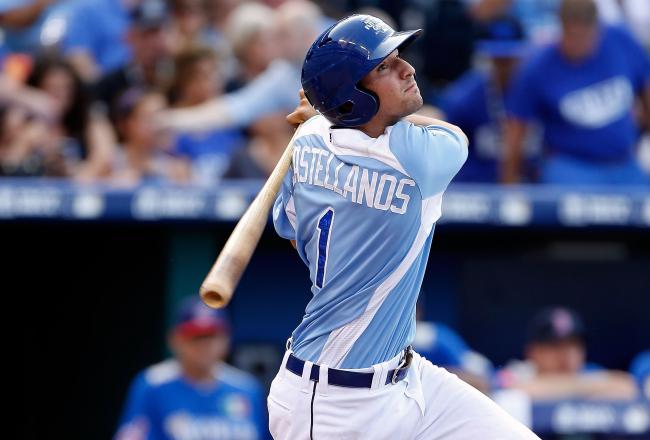
Below is a graphic representation of the Detroit Tigers 2016 projected lineup, there is a text version further down the page.
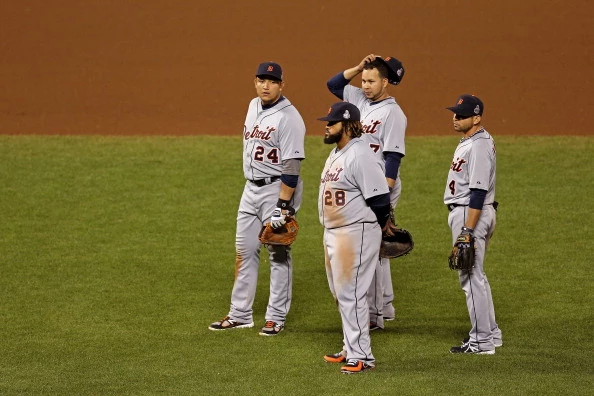
Projected 2016 Detroit Tigers starting lineup
Catcher- Alex Avila
First Base- Prince Fielder
Second Base- Jhonny Peralta
Third Base- Nick Castellanos
Short Stop- Eugenio Suarez
Left Field- Austin Jackson
Center Field- Austin Schotts
Right Field- Avisail Garcia
Designated Hitter- Miguel Cabrera
No. 1 Starter- Justin Verlander
No. 2 Starter- Max Scherzer
No. 3 Starter- Doug Fister
No. 4 Starter- Drew Smyly
No. 5 Starter- Rick Porcello
Closer- Bruce Rondon
After trading away two of the two top prospects in the Tigers farm system during the 2012 season, what is left on the farm that could help Detroit in the near future?
- Nick Castellanos 3B/OF
- Avisail Garcia OF
- Bruce Rondon RHP
- Jake Thompson RHP
- Austin Schotts OF
- Danry Vasquez OF
- Tyler Collins OF
- Casey Crosby LHP
- Eugenio Suarez SS/2B
- Adam Wilk LHP
Garcia is an electrifying outfielder who came to the majors at the end of August and made his presence known in Detroit. He has a plus bat and an incredible arm from the outfield. One problem with him however, is that Manager Jim Leyland only played him against left-handed pitchers, which he did well against. But, being a young player, if he only ever sees action against lefties, then his numbers against righties will only continue to fall. Garcia will be a very good outfielder, but he needs to play every day, and if he can't get that in Detroit, then he should spend half the season in Toledo getting everyday action before he moves permanently to right field in Detroit.
Bruce Rondon has had his name thrown around a lot lately, as a solution to the closer vacancy in Detroit. Rondon is known for his blazing fastball that can easily hit triple digits, but he also possesses what could be the best slider in the Tigers organization. If Rondon has a third pitch that even comes close to his fastball and slider, then he will earn the closer role in 2013 and will not relinquish it for years.
Jake Thompson and Austin Schotts were both drafted by the Tigers in 2012. Thompson has a good arm and is capable of making hitters miss, but he is still very raw and will require several more years in the minors before he will be ready to break into the big leagues.
Schotts however, could have been the steal of the 2012 draft. The outfielder is said to have 80 speed and said to be able to beat Mike Trout and Michael Bourn in a footrace. Schotts elected to join the Tigers rather than go to college, and Detroit couldn't be happier about it. In his first 22 games as a pro, Schotts hit .388/.440/.538 with 7 doubles, a triple, a homerun, and 11 stolen bases in 13 tries.
Schotts will not take much longer in the minors before he is ready for an everyday job in Detroit. With his exceptional speed, he could be a great fit in the massive Comerica Park center field. This would shift Austin Jackson to left field for the Tigers, which could work well, as Detroit has been on the lookout for a good left fielder for a decade.
Danry Vasquez was signed when he was 16-years old and given a seven figure signing bonus by the Tigers in 2010. There have been some mixed reviews on his fielding, but he stands out as being a good player even when not in the spotlight. Vasquez does possess a strong arm from the outfield and as his fielding improves he will only become more and more inticing for Detroit to either place in the lineup or trade for a top-tier MLB talent.
The Tigers continue the glut of outfield talent with Tyler Collins, who won the National Junior College Athletic Asssociation Player of the Year from Howard College in Texas in 2011. He batted .488 (105-for-215) last spring with 34 doubles, 19 homers and 82 RBI. Collins was selected in the sixth round of the 2011 MLB draft and will likely be a trade piece before he makes it to the majors in Detroit.
Casey Crosby is another name Tigers fans should know, he has spent some time in the Detroit rotation the last several years. Crosby has struggled to stay healthy since being drafted in 2007, and following Tommy John's surgery in 2008 Crosby needs to get some innings under his belt. He possesses a heavy, mid-90's fastball and while he has a good curveball, he needs work to consistently throw it for strikes. A changeup adds depth to his repertoire, but it needs a bit of work still.
Eugenio Suarez breaks the outfielder daze, and the switch-hitting infielder is a breath of fresh air for the Tigers. Although Suarez is on the smaller side, but he possesses good defensive ability while also hitting well. It appears as though the Tigers scouts found gold with this IFA prospect. The lack of infield prospects and his good skill set should have him in the majors quickly.
Adam Wilk is yet another familiar name for Tigers fans. Wilk is a control pitcher, who does not have great velocity, but he does have great control. He consistently throws strikes, but it is hard to see Wilk as anything more than a bullpen pitcher who could see occasional spot starts.
Below is a graphic representation of the Detroit Tigers 2016 projected lineup, there is a text version further down the page.
Projected 2016 Detroit Tigers starting lineup
Catcher- Alex Avila
First Base- Prince Fielder
Second Base- Jhonny Peralta
Third Base- Nick Castellanos
Short Stop- Eugenio Suarez
Left Field- Austin Jackson
Center Field- Austin Schotts
Right Field- Avisail Garcia
Designated Hitter- Miguel Cabrera
No. 1 Starter- Justin Verlander
No. 2 Starter- Max Scherzer
No. 3 Starter- Doug Fister
No. 4 Starter- Drew Smyly
No. 5 Starter- Rick Porcello
Closer- Bruce Rondon
Tuesday, November 20, 2012
Tigers Rumored To Be Pursuing Stephen Drew
By Sean Gagnier
After the Oakland A's turned down their $10M option on Stephen Drew, the free agent began popping up on several team's radars, including the Detroit Tigers.
Oakland is not out of the hunt for Drew though, they just want to ink him to a less rich deal. Other teams in the hunt are the Boston Red Sox and New York Yankees, although both teams see Drew more as an excellent insurance plan for their everyday shortstops.
Detroit however, despite picking up the option on Jhonny Peralta after the World Series, consider Drew to be a starting shortstop and are rumored to be pursuing him.
Picking up Drew doesn't add much to the Tigers roster, it is not a positive move, but more of a horizontal one. In 2012 Peralta hit .239/.305/.384 in 585 appearances while Drew turned in a .223/.309/.348 performance in 327 appearances.
Drew however, was coming off a year of rehab from a severe ankle injury, something Detroit believes held his numbers down.
If Detroit does indeed sign Drew, they will likely shop Peralta who has drawn interest from several teams, including the Arizona Diamondbacks. Should Drew don the "Olde English D" then the Tigers could trade Peralta quickly to get a prospect or two in return.
Monday, November 12, 2012
Tigers Close In On Hunter, Make FA Signing
By Sean Gagnier
It's no secret that the Tigers are targeting corner outfielders this offseason. With the struggles of Delmon Young, who is now gone, and the inexperience of Avisail Garcia, Detroit wants to add a veteran presence to the outfield, and Torii Hunter is perfect.
Hunter is being pursued by several teams, but the top two appear to be the Tigers and the Texas Rangers. One team will have their prize sooner rather than later, as Hunter told MLB Network that he expects to "sign quickly."
Detroit sees Hunter as a near perfect fit on and off the field in the Motor City. The corner outfield spots are important to the Tigers, and adding a veteran presence could help give the team the leadership in the clubhouse that appeared to be lacking during the 2012 season.
Texas is also an option for Hunter, who makes his home close to the Ballpark at Arlington in Texas.
Other teams in the hunt for Hunter are the; Red Sox, Dodgers, Yankees, Braves and Angels.
Free Agent Moves
Detroit has signed right-hander Shawn Hill to a minor league contract. Hill opted for free agency after appearing in just one game for the Blue Jays last season. The 31-year old rightie spent most of the 2012 season in Triple-A and posted stats of; 4.52 ERA, 5.2 K/9, 2.2 BB/9 in 89 2/3 innings.
Saturday, November 10, 2012
Tigers Bring Back Bonderman....Maybe
By Sean Gagnier
Former-Tiger hurler Jeremy Bonderman is looking to return to the game, and the Tigers reportedly are interesting in bringing him back. It was reported on Friday that the team and Bonderman had reached a deal, but no details were released and when contacted by MLB.com's Jason Beck, Bonderman said that the deal was "news to him."
So, maybe Bonderman isn't on his way back to Detroit, or maybe he is, who knows.
Bonderman last pitched for Detroit in 2010 before suffering a shoulder injury that forced him to have surgery. In eight seasons with the Tigers, Bonderman posted a 4.89 ERA and 1.402 WHIP, not exactly numbers that are going to blow the world away.
If the Tigers do indeed sign Bonderman, it will likely be to a minor league deal with an invitation to spring training. Should Detroit like what they see out of Bonderman in the spring he could wind up with the club, otherwise he could spend some time in Toledo returning to form.
Closer News
The Tigers have said that they will not pursue former-Yankee reliever Rafael Soriano for the vacant closers role. Instead, Detroit has indicated that the closer role will be filled from within and has marked 21-year old reliever Bruce Rondon as a candidate.
Wednesday, October 31, 2012
Tigers Lloyd McClendon Is Candidate for Marlins Job
By Sean Gagnier
UPDATE: McClendon has missed out on the Marlins job and will return to the Detroit Tigers next season and continue serving as the hitting coach.
The Detroit Tigers didn't waste any time in getting the team ready for next season, announcing several roster moves and the return of manager Jim Leyland. Leyland said at his press conference that the entirety of his coaching staff would be invited to return next season, with one change.
The invitation to return was extended to all of Leyland's coaches, but it was explained that there would be one change. Rumors are that the change will involve third base coach Gene Lamont, who is oft-criticized for his choices at that location. A replacement candidate for third base coach could be current first base coach Tom Brookens.
However, there may be more than just the one coaching move come next season. After a disappointing season in Miami, the Marlins have fired manager Ozzie Guillen and are now looking for his replacement. Apparently the "all-Latin team" went out the window when the Marlins record went south, and Miami has interviewed Tigers hitting coach Lloyd McClendon for the vacancy.
McClendon reportedly interviewed with the Marlins on Oct. 30. He makes sense for the under performing team, as he helped to turn Austin Jackson into a solid leadoff hitter and oversaw a Triple Crown winner. But McClendon isn't the only candidate by far; the Marlins are also looking at Larry Bowa, currently of MLB Network, and Mike Redmond, currently manager of the Single-A Dunedin Blue Jays. Miami was also considering Bryan Price, but he has since withdrawn his name.
Tuesday, October 30, 2012
Tigers manager Jim Leyland set to return in 2013
By Sean Gagnier
Tigers manager Jim Leyland is slated to return for his eighth season as manager of the Detroit Tigers, according to Tom Gage. The contract extension through 2013 announcement could be made as early as today.
It was no secret that both sides wanted to try this again. General Manager Dave Dombrowski repeatedly said that he would love to have Leyland back, if he wanted to come back. And Leyland continually said that he wanted to manage more, but wanted to see how things went.
Well, the love birds have finally gotten back together. No information regarding the length or value of Leyland's new contract have come out yet, but reports are that the two sides have a deal done.
While it may not always be easy to agree with the calls that Leyland has made this season, it is hard to argue with the results. Under his management, the Tigers have gone to three postseasons, won back-to-back AL Central titles and been to the World Series twice. The outcomes of those Fall Classic's was not what was hoped, but it is hard to complain about being one of the last two standing.
If Leyland can keep his team playing like they did in the American League Championship Series next season, then things will be great for Detroit. His coaches will come back with him. We see no reason why they shouldn't. Back-to-back AL Central titles and an AL Championship speak a bit to not breaking up the team.
Detroit Tigers tapped as World Series Favorites for 2013
By Sean Gagnier
Yes, that's right. The team that got outright trounced in the World Series and embarrassed on national television for four straight game apparently tests well in Las Vegas.
2012 was a year of extremely high expectations. Hell, even the Tigers' American League Championship feels empty. This team looked like world beaters, and they still do, not to mention they will add Victor Martinez next season, a guy who hit .400+ with RISP in 2011.
So while it may be too soon for most Tigers fans, it's never too early in Vegas. According to the betting service Bovada, the Tigers are 6-to-1 favorites to win the World Series next season. They are closely followed by the Yankees (not sure why, as there will be a lot of movement in the Bronx this off season) at 7-to-1 and the San Francisco Giants to repeat at 10-to-1.
Looking toward next season, it isn't out of the question, or even the least bit naive to say that the Tigers could win their third straight American League Central crown. The division will be just as bad, as if Detroit can actually put together a season where they appear to actually care about playing competitive baseball then it should be a cakewalk.
That being said, if you were a betting man, why not slap down a dollar on the new-to-the-AL Houston Astros to win the whole thing. Worst that happens is you're out a dollar; best case scenario, you win $150.
Full Odds:
Detroit Tigers............................6/1
New York Yankees..................7/1
San Francisco Giants...............10/1
Texas Rangers.........................12/1
Washington Nationals.............12/1
Los Angeles Angels................12/1
Philadelphia Phillies................14/1
St. Louis Cardinals..................14/1
Cincinnati Reds.......................14/1
Atlanta Braves.........................14/1
Los Angeles Dodgers..............18/1
Tampa Bay Rays.....................20/1
Boston Red Sox.......................22/1
Arizona Diamondbacks...........25/1
Baltimore Orioles.....................25/1
Milwaukee Brewers.................25/1
Oakland Athletics....................25/1
Chicago White Sox..................28/1
Pittsburgh Pirates.....................30/1
Toronto Blue Jays....................35/1
Seattle Mariners.......................40/1
Miami Marlins..........................40/1
New York Mets.......................40/1
San Diego Padres.....................60/1
Minnesota Twins.....................66/1
Chicago Cubs..........................75/1
Cleveland Indians....................75/1
Colorado Rockies....................75/1
Kansas City Royals.................75/1
Houston Astros......................150/1
Yes, that's right. The team that got outright trounced in the World Series and embarrassed on national television for four straight game apparently tests well in Las Vegas.
2012 was a year of extremely high expectations. Hell, even the Tigers' American League Championship feels empty. This team looked like world beaters, and they still do, not to mention they will add Victor Martinez next season, a guy who hit .400+ with RISP in 2011.
So while it may be too soon for most Tigers fans, it's never too early in Vegas. According to the betting service Bovada, the Tigers are 6-to-1 favorites to win the World Series next season. They are closely followed by the Yankees (not sure why, as there will be a lot of movement in the Bronx this off season) at 7-to-1 and the San Francisco Giants to repeat at 10-to-1.
Looking toward next season, it isn't out of the question, or even the least bit naive to say that the Tigers could win their third straight American League Central crown. The division will be just as bad, as if Detroit can actually put together a season where they appear to actually care about playing competitive baseball then it should be a cakewalk.
That being said, if you were a betting man, why not slap down a dollar on the new-to-the-AL Houston Astros to win the whole thing. Worst that happens is you're out a dollar; best case scenario, you win $150.
Full Odds:
Detroit Tigers............................6/1
New York Yankees..................7/1
San Francisco Giants...............10/1
Texas Rangers.........................12/1
Washington Nationals.............12/1
Los Angeles Angels................12/1
Philadelphia Phillies................14/1
St. Louis Cardinals..................14/1
Cincinnati Reds.......................14/1
Atlanta Braves.........................14/1
Los Angeles Dodgers..............18/1
Tampa Bay Rays.....................20/1
Boston Red Sox.......................22/1
Arizona Diamondbacks...........25/1
Baltimore Orioles.....................25/1
Milwaukee Brewers.................25/1
Oakland Athletics....................25/1
Chicago White Sox..................28/1
Pittsburgh Pirates.....................30/1
Toronto Blue Jays....................35/1
Seattle Mariners.......................40/1
Miami Marlins..........................40/1
New York Mets.......................40/1
San Diego Padres.....................60/1
Minnesota Twins.....................66/1
Chicago Cubs..........................75/1
Cleveland Indians....................75/1
Colorado Rockies....................75/1
Kansas City Royals.................75/1
Houston Astros......................150/1
Monday, October 29, 2012
What do the Detroit Tigers do to improve their pitching for 2013?
By Sean Gagnier
Even as the Detroit Tigers watched the San Francisco Giants celebrate their World Championship at Comerica Park, questions arose as to what happens for 2013. One of those questions could be, how to the Tigers improve their pitching?
There are several options but two stand out more than any other.
General Manager Dave Dombrowski could make a move to resign Anibal Sanchez and keep him in Detroit for the long term. While that could be the preferred option, it could prove to be an expensive one. Sanchez, despite not receiving much run support in Detroit, posted a 2.15 ERA and 44 K's in his last eight outings and has said that he is open to returning to Motown.
That being said, Detroit will not be the only team pursuing Sanchez this off-season. Teams such as the New York Yankees, Boston Red Sox and Kansas City Royals will be in the hunt for Sanchez's services, which could drive his salary up quite steep.
Sanchez is 28 years old and only has a career record of 48-51, but ESPN's Buster Olney reports that he could get a contract worth anywhere from $30 to $60 million. If those figures are accurate, the Tigers could very well let Sanchez walk, seeing as he is slated to be the fourth starter behind Justin Verlander, Doug Fister and Max Scherzer.
The other option open to the Tigers would be the trade route, and despite popular thoughts by fans, Rick Porcello remains a viable trade asset for Detroit. Porcello is a solid ground ball pitcher and could bring a decent return, either in the form of a starter or bullpen help.
As a ground ball pitcher Porcello is well suited for a National League club, instead of the one he currently plays for that has very poor infield defense. A ground ball pitcher is only as good as his infield defense, and well...look who is in the infield for Detroit.
Porcello still is well regarded among other general managers and appears to be a fit in Minnesota, San Diego or Pittsburgh. A trade of Porcello for Joel Hanrahan or Aaron Crow could very well be a realistic possibility.
Even as the Detroit Tigers watched the San Francisco Giants celebrate their World Championship at Comerica Park, questions arose as to what happens for 2013. One of those questions could be, how to the Tigers improve their pitching?
There are several options but two stand out more than any other.
General Manager Dave Dombrowski could make a move to resign Anibal Sanchez and keep him in Detroit for the long term. While that could be the preferred option, it could prove to be an expensive one. Sanchez, despite not receiving much run support in Detroit, posted a 2.15 ERA and 44 K's in his last eight outings and has said that he is open to returning to Motown.
That being said, Detroit will not be the only team pursuing Sanchez this off-season. Teams such as the New York Yankees, Boston Red Sox and Kansas City Royals will be in the hunt for Sanchez's services, which could drive his salary up quite steep.
Sanchez is 28 years old and only has a career record of 48-51, but ESPN's Buster Olney reports that he could get a contract worth anywhere from $30 to $60 million. If those figures are accurate, the Tigers could very well let Sanchez walk, seeing as he is slated to be the fourth starter behind Justin Verlander, Doug Fister and Max Scherzer.
The other option open to the Tigers would be the trade route, and despite popular thoughts by fans, Rick Porcello remains a viable trade asset for Detroit. Porcello is a solid ground ball pitcher and could bring a decent return, either in the form of a starter or bullpen help.
As a ground ball pitcher Porcello is well suited for a National League club, instead of the one he currently plays for that has very poor infield defense. A ground ball pitcher is only as good as his infield defense, and well...look who is in the infield for Detroit.
Porcello still is well regarded among other general managers and appears to be a fit in Minnesota, San Diego or Pittsburgh. A trade of Porcello for Joel Hanrahan or Aaron Crow could very well be a realistic possibility.
Sunday, October 28, 2012
Who Closes for the Detroit Tigers in 2013?
By Sean Gagnier
The World Series is over and congratulations are in order to the San Fransisco Giants. Their pitching staff dominated the Detroit Tigers all series.
As the depression of being swept out of the fall classic subsides, the Tigers will have to look at themselves and see where they need improvement. And anyone with eyes can see that the biggest area in need of improvement is the closers role.
Jose Valverde may have been perfect in 2011, but he was anything but that in 2012. And in the 2012 postseason, he was the epitome of worthless. He was so bad that Manager Jim Leyland turned to lefty-specialist Phil Coke to serve as his inpromptu-closer for the length of the postseason.
Valverde has without a doubt seen his last game in a Tigers uniform, but while his departure will certainly come as a relief to many Tigers fans, it also leaves a void at the back end of the Detroit bullpen. Who should fill it? There are several in-house options to consider as well as a free agent and one on the trade market, here they are.
Free Agents
Rafael Soriano - New York Yankees, signed through 2013 (3yrs/$35M)
Trade Market
Chris Perez - Cleveland Indians, signed through 2015 (arbitration eligible, $4.5M)
Phil Coke - Detroit Tigers, signed through 2015 (arbitration eligible, $1.1M)
The World Series is over and congratulations are in order to the San Fransisco Giants. Their pitching staff dominated the Detroit Tigers all series.
As the depression of being swept out of the fall classic subsides, the Tigers will have to look at themselves and see where they need improvement. And anyone with eyes can see that the biggest area in need of improvement is the closers role.
Jose Valverde may have been perfect in 2011, but he was anything but that in 2012. And in the 2012 postseason, he was the epitome of worthless. He was so bad that Manager Jim Leyland turned to lefty-specialist Phil Coke to serve as his inpromptu-closer for the length of the postseason.
Valverde has without a doubt seen his last game in a Tigers uniform, but while his departure will certainly come as a relief to many Tigers fans, it also leaves a void at the back end of the Detroit bullpen. Who should fill it? There are several in-house options to consider as well as a free agent and one on the trade market, here they are.
Free Agents
Rafael Soriano - New York Yankees, signed through 2013 (3yrs/$35M)
- 67.2 IP / 2.26 ERA / 42 SV / 1.167 WHIP / 9.2 SO/9
- While Soriano may not be a free agent quite yet, all indications are that he will opt out of the final year of his contract with the Yankees and will test the free agent market. And that market could become very lucrative for him.
- After the season ending injury to Mariano Rivera it was up to Soriano to take over the closers role, and he did an exceptional job. His 42 saves are the second most of his career and his WHIP among the best in the league
- Upside: Soriano is an elite caliber closer who could come in and immediately have an impact for the Tigers.
- Downside: He will cost a pretty penny. Soriano isn't opting out of the final year of a $35M deal to get less money and with the Yankees competing with several other teams for his services, his contract will certainly balloon out of the Tigers price range.
Trade Market
Chris Perez - Cleveland Indians, signed through 2015 (arbitration eligible, $4.5M)
- 57.2 IP / 3.59 ERA / 39 SV / 1.127 WHIP / 9.2 SO/9
- Cleveland is starting a new era under Manager Terry Francona, and Perez showed that he was one of the most outspoken and driven members of last season's Indians club. However, Cleveland has it's eyes on their closer of the future in Vinnie Pestano. While Perez gives the Indians passion and energy, he could also bring them solid prospects in return.
- The Indians like Perez, the only way they part ways with him is if they believe Pestano is ready to take over the mantle of being the closer. And that has yet to be seen.
- Upside: Perez would bring a fire and passion to the Tigers that has appeared to be missing since the loss of Victor Martinez. He is unconventional, but his style of pitching would fit well in the cavern that is Comerica Park.
- Downside: Pestano doesn't appear to be ready to become the closer just yet, but if the Indians do decide to go with him, they will want quite a bit in return for Perez and they would be insane to trade him within the division.
Phil Coke - Detroit Tigers, signed through 2015 (arbitration eligible, $1.1M)
- 54 IP / 4.00 ERA / 1 SV / 1.648 WHIP / 8.5 SO/9
- Coke was not the picture of consistency during the regular season, but when Valverde imploded in the postseason, Leyland turned to Coke and he delivered. In his 10 innings pitched in the 2012 postseason, Coke allowed just one run.
- Upside: Coke being a lefty, would be something different than most closers. He has shown that when the pressure is on him he is capable of producing and giving maximum effort. The guy sprints to the mound from the bullpen every single time his name is called and he refuses to give less than 100 percent, that's something you look for in a closer.
- Downside: The postseason is one thing, the pressure and adrenaline could have helped him, but it remains to be seen if he can take his playoff success and translate it into regular season consistency. If Coke pitches the way he did during the regular season then he is not closer material, but if the Tigers get the postseason Coke, then they would have found themselves something special.
- 13.1 IP / 0.68 ERA / 0 SV / 1.050 WHIP / 12.2 SO/9
- Alburquerque possesses a devastating slider and a decent fastball to keep batters honest, but he has yet to complete a complete season after two injuries cut his 2011 and 2012 short. In 2011, Alburquerque was struck in the back of the head by a fly ball during batting practice and missed the final several months of the season. In 2012, he suffered a knee injury and was unable to return to action until late in the year.
- When healthy and on, Alburquerque is close to unhittable. However, his durability has to come into question as well as his relative inexperience. But if Alburquerque is capable of producing the same way he did to close out the season this year, next season, then he could be a very interesting candidate.
- Upside: His pitches have great movement and he doesn't appear to be phased with runners on base. Detroit has Alburquerque signed long term, meaning that if he does have what it takes to close games, the Tigers could use the money they save on him for other pieces.
- Downside: Alburquerque has yet to complete a season and is for all intents and purposes still a rookie. Handing the ball to someone as inexperienced as Alburquerque could prove costly to the Tigers if he isn't entirely ready for the pressure of the closers role.
- (A+, AA, AAA) 53.0 IP / 1.53 ERA / 29 SV / 1.094 WHIP / 11.2 SO/9
- From scouting reports and other outlets it is apparent that Rondon possesses an impressive fastball, upper-nineties, and several decent off-speed pitches. Rondon was good enough in 2012 to progress from High-A Lakeland to Double-A Erie and on to Triple-A Toledo all while serving as the closer.
- Upside: Rondon has a devastating fastball that could overpower many major league hitters, and being an unknown rookie could benefit him against batters who have not yet seen him. If he can improve his change-up, Rondon could be a very good closer for years to come.
- Downside: Much like Alburquerque, Rondon being a rookie is dangerous for the Tigers. His inexperience and complete lack of time in the major leagues could lead to him playing a role in the bullpen in 2013, but keep him from assuming the closers role for several years.
Saturday, October 27, 2012
Detroit Tigers Will Have Work Cut Out for Them in Arbitration
By Sean Gagnier
It may be early, the Tigers aren't dead yet in the World Series, but looking at a 3-0 series deficit, it couldn't hurt to look to the 2013 season.
First off, the Tigers already high payroll could get much higher next season, with nine players eligible for salary arbitration.
Arbitration Eligible Tigers
Includes player's 2012 salary
Of the nine players eligible for arbitration, Raburn does not deserve a pay raise at all, in fact he probably should have to pay Mike Illich for being as bad as he is. No chance he is back with the team next season.
With Detroit likely picking up the $6 million option on Jhonny Peralta, they will have no need for Kelly and will likely cut him.
Boesch more than likely has seen his last game in a Tigers uniform. He did not follow up his good 2011 season with a equally impressive 2012 season, and has been left off all three Tigers postseason rosters. If that isn't a sign that Detroit is ready to part ways with Boesch, then nothing is. Not to mention the glut of outfielders the Tigers have right now.
Scherzer will see yet another big pay raise; last season Scherzer saw his salary grow from $600,000 to $3.75 million. If things hold like they did last season, Scherzer could be bringing in quite a bit more money next year.
Like Scherzer, the other Tigers eligible for arbitration, aside from Raburn, Boesch and Kelly, will all likely see a bump in pay and return to the club next season without any incidences.
With Raburn, Boesch and Kelly being shown the door, Detroit will add to it's payroll without adding a single player. That doesn't bode well for being active with free agents.
Savings: $3.5 million
Free Agent Tigers
Valverde will be on the first plane out of Detroit in the off-season and will never come back.
Delmon Young may have been named the ALCS MVP, but that doesn't make up for a horrible regular season and his bat, when hot, in no way comes close to making up for his defense in left field, if you can even call it that. Young's -29 RAA is one of the lowest in the entire league, meaning that when he plays left field, Young gives up 29 more runs than an average player. And even his bat doesn't save him, Young boasted a -9Rbat, runs batted in by position. So not only can he not field, he can't hit. Wave g'bye to Young this off-season.
Laird has struggled in the postseason offensively, and didn't have the best year at the plate during the regular season, but he has served as a solid backup for Alex Avila all year. With Victor Martinez returning next season, the Tigers would have three catchers on the roster, but it also depends on how they plan to use Martinez.
The only problem with using Martinez, Laird and Avila, is that Martinez is owed $13 million next season. While that is quite a hefty sum, if he can produce with RISP like he did in 2011 then he will be worth every penny.
That being said, we would prefer to see Martinez used as the DH on a daily basis next season and see Laird return at $1 million or a little more. Martinez is too valuable to this team to put him behind the plate and risk him getting hurt or wearing out what little is left of his knees. By resigning Laird, all three catchers could work with the pitching staff and if absolutely necessary Martinez could serve as the emergency catcher. Laird works well with Scherzer and Porcello, while Avila tends to work better with Verlander and Fister. Why break up the band now?
While Sanchez has yet to see any bump in run support moving from Miami to Detroit, he appears to like the club and the fans, but it has yet to be seen if that will turn into him resigning with the Tigers. With Detroit cutting ties to Valverde, Boesch and Young, there should be enough money to offer Sanchez a competitive deal to keep him in Motown.
He may not have had the best first few outings for Detroit, but Sanchez has shown that he is as capable a pitcher as any of the other guys on the staff. Sanchez will receive contracts worth absurd money, no doubt, but the Tigers will likely offer him something in the neighborhood of $9-10 million per season.
Savings: $15.75 million
Total Savings: $19.25 million
What about the 'pen?
Phil Coke has shown that he is capable of handling the closers role in the postseason, why not keep him in that role? With Coke serving as the closer, the 7th and 8th inning roles could be left up to Octavio Dotel and Joaquin Benoit.
Moving Coke to the closer, leaves the Tigers in need of a situational lefty, which could be filled by Darin Downs. Continuing to use Al Albuquerque in tight situations would be a solid move and so would be moving Bruce Rondon up from the Toledo Mud Hens and into the Tigers bullpen.
Detroit made a good run in 2011, but was hampered by injuries. In 2012, an American League Championship is nothing to sneeze at, but the Tigers have no one to blame but themselves for under-performing in the World Series. If Detroit wants to stay at the top of the AL for a long time, they need to reward success while promoting young cheap talent from within.
It may be early, the Tigers aren't dead yet in the World Series, but looking at a 3-0 series deficit, it couldn't hurt to look to the 2013 season.
First off, the Tigers already high payroll could get much higher next season, with nine players eligible for salary arbitration.
Arbitration Eligible Tigers
Includes player's 2012 salary
- Max Scherzer, $3.75 million
- Rick Porcello, $3.1 million
- Ryan Raburn, $2.1 million
- Phil Coke, $1.1 million
- Don Kelly, $900,000
- Alex Avila, $510,000
- Doug Fister, $507,500
- Brennan Boesch, $502,500
- Austin Jackson, $500,000
Of the nine players eligible for arbitration, Raburn does not deserve a pay raise at all, in fact he probably should have to pay Mike Illich for being as bad as he is. No chance he is back with the team next season.
With Detroit likely picking up the $6 million option on Jhonny Peralta, they will have no need for Kelly and will likely cut him.
Boesch more than likely has seen his last game in a Tigers uniform. He did not follow up his good 2011 season with a equally impressive 2012 season, and has been left off all three Tigers postseason rosters. If that isn't a sign that Detroit is ready to part ways with Boesch, then nothing is. Not to mention the glut of outfielders the Tigers have right now.
Scherzer will see yet another big pay raise; last season Scherzer saw his salary grow from $600,000 to $3.75 million. If things hold like they did last season, Scherzer could be bringing in quite a bit more money next year.
Like Scherzer, the other Tigers eligible for arbitration, aside from Raburn, Boesch and Kelly, will all likely see a bump in pay and return to the club next season without any incidences.
With Raburn, Boesch and Kelly being shown the door, Detroit will add to it's payroll without adding a single player. That doesn't bode well for being active with free agents.
Savings: $3.5 million
Free Agent Tigers
- Jose Valverde, $9 million
- Delmon Young, $6.75 million
- Gerald Laird, $1 million
- Anibal Sanchez, $8 million
Valverde will be on the first plane out of Detroit in the off-season and will never come back.
Delmon Young may have been named the ALCS MVP, but that doesn't make up for a horrible regular season and his bat, when hot, in no way comes close to making up for his defense in left field, if you can even call it that. Young's -29 RAA is one of the lowest in the entire league, meaning that when he plays left field, Young gives up 29 more runs than an average player. And even his bat doesn't save him, Young boasted a -9Rbat, runs batted in by position. So not only can he not field, he can't hit. Wave g'bye to Young this off-season.
Laird has struggled in the postseason offensively, and didn't have the best year at the plate during the regular season, but he has served as a solid backup for Alex Avila all year. With Victor Martinez returning next season, the Tigers would have three catchers on the roster, but it also depends on how they plan to use Martinez.
The only problem with using Martinez, Laird and Avila, is that Martinez is owed $13 million next season. While that is quite a hefty sum, if he can produce with RISP like he did in 2011 then he will be worth every penny.
That being said, we would prefer to see Martinez used as the DH on a daily basis next season and see Laird return at $1 million or a little more. Martinez is too valuable to this team to put him behind the plate and risk him getting hurt or wearing out what little is left of his knees. By resigning Laird, all three catchers could work with the pitching staff and if absolutely necessary Martinez could serve as the emergency catcher. Laird works well with Scherzer and Porcello, while Avila tends to work better with Verlander and Fister. Why break up the band now?
While Sanchez has yet to see any bump in run support moving from Miami to Detroit, he appears to like the club and the fans, but it has yet to be seen if that will turn into him resigning with the Tigers. With Detroit cutting ties to Valverde, Boesch and Young, there should be enough money to offer Sanchez a competitive deal to keep him in Motown.
He may not have had the best first few outings for Detroit, but Sanchez has shown that he is as capable a pitcher as any of the other guys on the staff. Sanchez will receive contracts worth absurd money, no doubt, but the Tigers will likely offer him something in the neighborhood of $9-10 million per season.
Savings: $15.75 million
Total Savings: $19.25 million
What about the 'pen?
Phil Coke has shown that he is capable of handling the closers role in the postseason, why not keep him in that role? With Coke serving as the closer, the 7th and 8th inning roles could be left up to Octavio Dotel and Joaquin Benoit.
Moving Coke to the closer, leaves the Tigers in need of a situational lefty, which could be filled by Darin Downs. Continuing to use Al Albuquerque in tight situations would be a solid move and so would be moving Bruce Rondon up from the Toledo Mud Hens and into the Tigers bullpen.
Detroit made a good run in 2011, but was hampered by injuries. In 2012, an American League Championship is nothing to sneeze at, but the Tigers have no one to blame but themselves for under-performing in the World Series. If Detroit wants to stay at the top of the AL for a long time, they need to reward success while promoting young cheap talent from within.
Friday, October 26, 2012
Lamont's Call to Send Fielder in Detroit Tigers Loss to Giants Was the Right One
By Sean Gagnier
Yes, the Tigers are down two games in the World Series. Yes, they are struggling to score runs. And yes, I am not the biggest fan of Gene Lamont. But his call to send Prince Fielder home in the second inning of Thursday's Game 2 was the right call.
Everyone knows that Fielder isn't the best guy on the base paths, but he isn't completely incompetent either.
On the play, Delmon Young scorches a ball down the left field line that pulls the left fielder, Gregor Blanco toward the corner of the field. Before the ball reaches the left field corner however, it ricochets off a cutout and takes a weird hop into left field. At this point, Fielder is around second base and is looking to Lamont at third for direction.
Just as Fielder hits third and begins his sprint toward home, Blanco comes up with the ball and fires it over the cut-off man, where Marco Scutaro takes the throw and has to make a perfect throw to the outside of the line in order to both avoid hitting Fielder and give catcher Buster Posey a shot at tagging him out.
Here's where the defense of the call comes in. Lamont knows that this team is struggling to score runs and he knows that getting one there could give Detroit momentum, so he takes a gamble.
Keep these things in mind when thinking about this play. 1. Scutaro needed to make an absolute perfect throw to the outside part of the plate to even give Posey a chance. 2. Posey does not block the plate anymore after suffering a broken ankle blocking the plate a few years ago.
Now imagine that you're Lamont with Fielder charging to third base. You know both of those things and you know that your runner is a biggun who has an awful lot of kinetic energy heading toward the plate. Keeping those things in mind, sending the runner is the right move.
The blame, if there must be some assigned, lies with Fielder and Jhonny Peralta. Peralta was in the on-deck circle during this play. As the player on-deck, you are responsible for moving behind the plate and helping to tell the runner when and how to slide to avoid any tag at the plate.
Peralta moved to the plate too late and didn't give Fielder any signals on where the throw was coming from. Because of the lack of help from Peralta, Fielder opted for a hook-slide in the middle of the plate rather than a straight-slide on the outside part of the plate.
Sure, if Lamont holds Fielder at third then the Tigers have runners at second and third with no outs and Peralta at the plate. You would assume that at least one of the next two batters could at least lift a ball to the outfield to score Fielder, but that wasn't the case.
If Lamont holds Fielder and the Tigers fail to come up with a hit, likely as they only had two, then it becomes a mistake to have held Fielder. Either call is a good one for different reasons, but this is the World Series, you have to go big or go home.
Yes, the Tigers are down two games in the World Series. Yes, they are struggling to score runs. And yes, I am not the biggest fan of Gene Lamont. But his call to send Prince Fielder home in the second inning of Thursday's Game 2 was the right call.
Everyone knows that Fielder isn't the best guy on the base paths, but he isn't completely incompetent either.
On the play, Delmon Young scorches a ball down the left field line that pulls the left fielder, Gregor Blanco toward the corner of the field. Before the ball reaches the left field corner however, it ricochets off a cutout and takes a weird hop into left field. At this point, Fielder is around second base and is looking to Lamont at third for direction.
Just as Fielder hits third and begins his sprint toward home, Blanco comes up with the ball and fires it over the cut-off man, where Marco Scutaro takes the throw and has to make a perfect throw to the outside of the line in order to both avoid hitting Fielder and give catcher Buster Posey a shot at tagging him out.
Here's where the defense of the call comes in. Lamont knows that this team is struggling to score runs and he knows that getting one there could give Detroit momentum, so he takes a gamble.
Keep these things in mind when thinking about this play. 1. Scutaro needed to make an absolute perfect throw to the outside part of the plate to even give Posey a chance. 2. Posey does not block the plate anymore after suffering a broken ankle blocking the plate a few years ago.
Now imagine that you're Lamont with Fielder charging to third base. You know both of those things and you know that your runner is a biggun who has an awful lot of kinetic energy heading toward the plate. Keeping those things in mind, sending the runner is the right move.
The blame, if there must be some assigned, lies with Fielder and Jhonny Peralta. Peralta was in the on-deck circle during this play. As the player on-deck, you are responsible for moving behind the plate and helping to tell the runner when and how to slide to avoid any tag at the plate.
Peralta moved to the plate too late and didn't give Fielder any signals on where the throw was coming from. Because of the lack of help from Peralta, Fielder opted for a hook-slide in the middle of the plate rather than a straight-slide on the outside part of the plate.
Sure, if Lamont holds Fielder at third then the Tigers have runners at second and third with no outs and Peralta at the plate. You would assume that at least one of the next two batters could at least lift a ball to the outfield to score Fielder, but that wasn't the case.
If Lamont holds Fielder and the Tigers fail to come up with a hit, likely as they only had two, then it becomes a mistake to have held Fielder. Either call is a good one for different reasons, but this is the World Series, you have to go big or go home.
Subscribe to:
Posts (Atom)